 Proof anchor
False positives are a known risk
Teaching guidance from MIT warns that detector software can falsely accuse students of misconduct.
Result
AI detector scores are not strong enough for punishment by themselves.
No. AI detectors can be useful prompts for a conversation, but education guidance and research point to false positives, false negatives, and bias risks.
FALSE means the claim conflicts with the pinned sources.
Claim
AI detectors are accurate enough to punish students without a second review.
Comeback
Copy this into the argument.That claim does not hold up. No. AI detectors can be useful prompts for a conversation, but education guidance and research point to false positives, false negatives, and bias risks. Source trail: factpage.ai/v/ai-detectors-are-accurate-enough-1up0f
Use it now
Paste the proof into the argument.The Weaponizer
"AI detectors are accurate enough to punish students without a second review."

No.  AI detectors can be useful prompts for a conversation, but education guidance and research point to false positives, false negatives, and bias risks.

FactPage marked it FALSE with distortion risk 95%. Source trail: factpage.ai/v/ai-detectors-are-accurate-enough-1up0f
3-line evidence
No. AI detectors can be useful prompts for a conversation, but education guidance and research point to false positives, false negatives, and bias risks. In a discipline case, a detector score should be checked against human review, writing process evidence, and the assignment context.
Claim visual
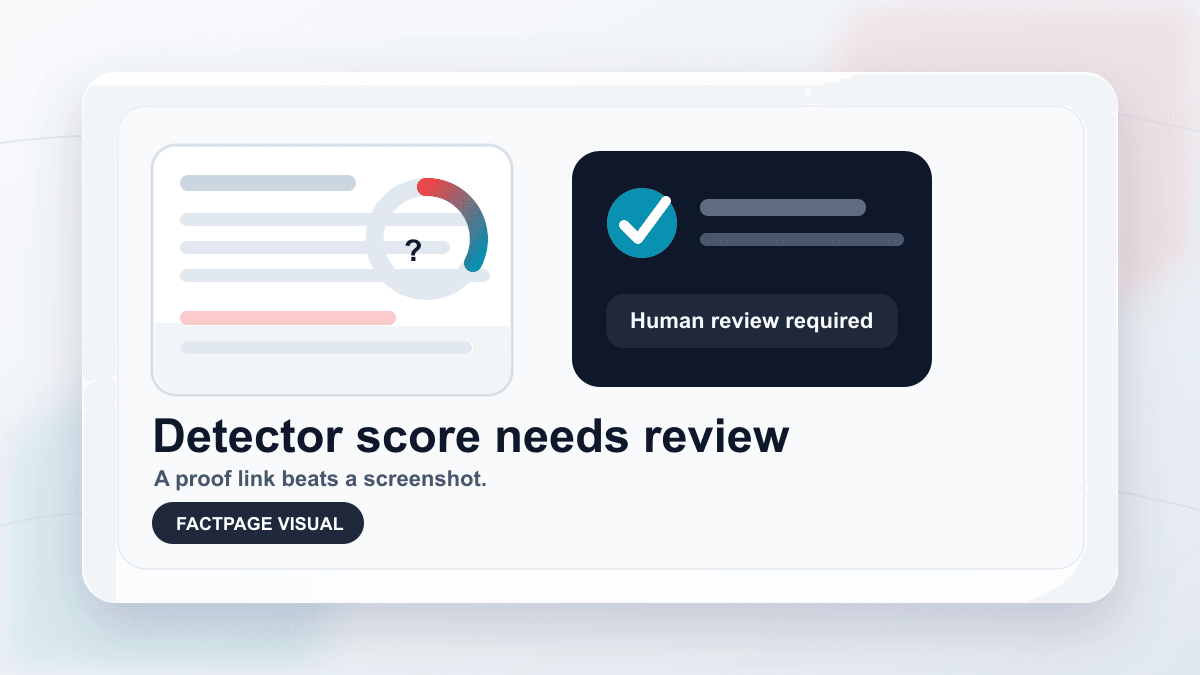
A claim-context visual for AI accusation receipts. The cited proof trail below carries the evidence.
Teaching guidance from MIT warns that detector software can falsely accuse students of misconduct.
Vanderbilt disabled Turnitin AI detection because the risk profile was not acceptable for students and faculty.
Stanford HAI reported that AI detectors can over-flag non-native English writing, making unsupported punishment especially risky.
Related proof guides
Use these when the argument is about the same topic, not this exact wording.
Think this missed something?
A user argues that AI detectors have self-reported accuracy rates of over 98% and should be trusted to issue punishments directly.
Keep it
Save this link to an email. No account required.
Paste it now
Copy the link, save the image, or post the proof while the thread is still warm.
Public claim check. Not legal, medical, financial, or safety advice.