 Proof anchor
Research found over-flagging of non-native writing
Stanford HAI summarized research showing popular detectors can misclassify non-native English essays as AI-generated.
Result
A flag against a non-native writer is a bias warning, not a confession.
No. Non-native English writers can be falsely flagged because some detectors treat predictable wording and simpler syntax as machine-like.
FALSE means the claim conflicts with the pinned sources.
Claim
Non-native speakers flagged by AI detectors probably used ChatGPT or a translator.
Comeback
Copy this into the argument.That claim does not hold up. No. Non-native English writers can be falsely flagged because some detectors treat predictable wording and simpler syntax as machine-like. Source trail: factpage.ai/v/non-native-speakers-flagged-by-ai-cft0o
Use it now
Paste the proof into the argument.The Weaponizer
"Non-native speakers flagged by AI detectors probably used ChatGPT or a translator."

No.  Non-native English writers can be falsely flagged because some detectors treat predictable wording and simpler syntax as machine-like.

FactPage marked it FALSE with distortion risk 90%. Source trail: factpage.ai/v/non-native-speakers-flagged-by-ai-cft0o
3-line evidence
No. Non-native English writers can be falsely flagged because some detectors treat predictable wording and simpler syntax as machine-like. A detector flag is not proof that the writer used ChatGPT or a translator; it is a reason to inspect drafts, process, and assignment context carefully.
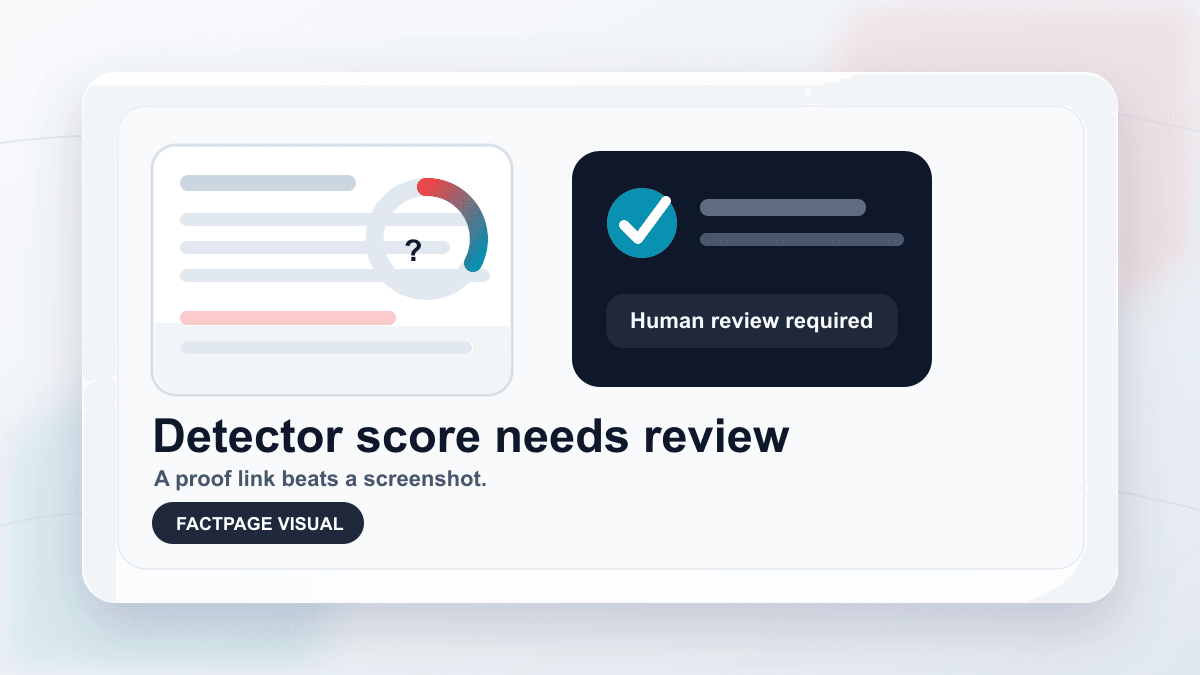
Claim visual
A claim-context visual for AI accusation receipts. The cited proof trail below carries the evidence.
Stanford HAI summarized research showing popular detectors can misclassify non-native English essays as AI-generated.
The study links the bias to constrained linguistic patterns, which can be normal for non-native academic writing.
Drafts, notes, prior writing, and a conversation about choices are stronger than treating a detector score as identity proof.
Related proof guides
Use these when the argument is about the same topic, not this exact wording.
Think this missed something?
Do you have evidence showing current AI detectors are unbiased against non-native English writers? Submit your proof.
Keep it
Save this link to an email. No account required.
Paste it now
Copy the link, save the image, or post the proof while the thread is still warm.
Public claim check. Not legal, medical, financial, or safety advice.